Redesigning Hiring Decisions at Scale
Context
Walmart’s field hiring process was fragmented across tools, teams, and workflows, making it difficult to assess candidates consistently and efficiently. Recruiters were forced to interpret incomplete signals across multiple systems, slowing decisions and increasing operational friction—especially at scale.
The challenge wasn’t designing another interface. It was designing a system that could consolidate hiring signals, reduce ambiguity, and support faster, higher-confidence decisions for field roles.
Leadership Challenge
Hiring at enterprise scale required navigating real constraints: legacy store systems, inconsistent data quality, offline environments, and high recruiter volume. Improving the experience meant aligning research, design, and business stakeholders around what actually mattered in hiring decisions—while operating inside tight operational realities.
The risk was clear: oversimplify and lose decision quality, or over-engineer and lose adoption.
What Jessa Led
-
Led end-to-end UX research to understand how recruiters evaluated candidates in practice, not just in policy
-
Identified decision bottlenecks and duplicated effort across fragmented hiring systems
-
Designed a centralized platform to surface meaningful hiring signals in one coherent experience
-
Partnered with recruiting, operations, and engineering to ensure feasibility in low-connectivity field environments
-
Drove clarity in agile delivery so teams could move faster without sacrificing quality
Metrics & Impact
-
Processed 150K+ data points from distributed store systems
-
Implemented offline-capable workflows to support poor field connectivity
-
Reduced duplicate touchpoints by 47%, streamlining recruiter effort
-
Improved speed and confidence in candidate assessment across field hiring teams
Outcome
Recruit Radar reshaped how hiring decisions were made by consolidating fragmented signals into a unified decision surface. The platform reduced operational friction, improved recruiter efficiency, and demonstrated how experience design can materially improve business outcomes—not by adding features, but by clarifying decisions.
Overview

Research Process:

Design Process
Due to confidentiality agreements and ongoing design iterations, low-fidelity wireframes and information architectures have been excluded. All data included is placeholder only, and do not represent any true employee information.

Product Designs
 |  |  |
|---|---|---|
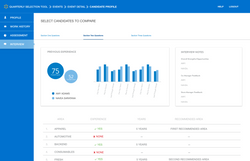 |  |  |
Mockups presented have been altered from their original forms in order to protect company information. No identifying information, layout or content is included.